Proving Commercial Gain in Domain Disputes
Uncovering the financial trails of parked pages provides the “smoking gun” evidence needed to establish bad faith in UDRP cases. This begins with identifying evidence of domain parking revenue as a catalyst for bad faith registration.
Parking Revenue as Bad Faith Evidence
Exploiting trademarks via parked pages satisfies UDRP bad faith criteria. We will examine the legal definition of commercial gain and distinguish between passive and active revenue models to clarify these violations.
Defining Commercial Gain Under UDRP

Under the Uniform Domain-Name Dispute-Resolution Policy (UDRP), “commercial gain” is a central pillar in proving bad faith. Paragraph 4(b)(iv) specifically targets situations where a registrant intentionally attempts to attract internet users to their website by creating a likelihood of confusion with the complainant’s mark. Even if the registrant does not personally curate the advertisements, the mere presence of pay-per-click (PPC) links related to the complainant’s industry serves as compelling proof of intent.
“The use of a domain name to host a parked page comprising pay-per-click links does not per se constitute bad faith… however, where such links demonstrate an attempt to capitalize on the reputation of a trademark, panels will find bad faith registration and use.” – WIPO Overview 3.0, Section 3.1.4.
According to WIPO Overview 3.0, Section 3.1.4, registrants bear ultimate responsibility for the content appearing on their parked pages. UDRP panels consistently maintain that the automated nature of pay-per-click links does not shield a respondent from a finding of bad faith:
“[T]he fact that such links are generated by a third party such as a registrar or auction platform (or their relevant affiliate) does not prevent a finding of bad faith.”
Understanding these legal thresholds is essential before distinguishing between passive and active revenue models.
Related topic reference: Udrp bad faith registration examples for brand protection.
Passive vs. Active Revenue Models
Panels distinguish between automated registrar defaults and deliberate monetization by looking for signs of active management. A common but frequently failing defense is the claim of “passive ignorance”—where a registrant argues they did not personally select the specific ads displayed. However, the WIPO Overview 3.0, Section 3.1.4 establishes that registrants are responsible for the content on their domains, regardless of whether the ad feed is automated or managed by a third-party parking service.
Identifying the shift from default parking to infringing activity requires forensic markers. This distinction is vital when preparing Domain Name Disputes, as it helps quantify the intent to capitalize on a brand’s reputation.
| Evaluation Factor | Benign Parking (Passive) | Infringing Parking (Active) |
|---|---|---|
| Ad Relevance | Generic or unrelated topics (e.g., “Internet”). | Links targeting the trademark or direct competitors. |
| Forensic Markers | Absence of personalized tracking IDs. | Persistent Publisher/Affiliate IDs found in HTML code. |
| DNS Configuration | Unconfigured; remains on registrar defaults. | Active migration to monetization servers (e.g., Sedo, ParkingCrew). |
| Monetization Profile | Incidental; no specific keyword triggers. | Aggressive layouts often yielding 18%–25% CTR. |
To secure a finding of bad faith, claimants must move beyond screenshots. Extracting technical metadata—specifically Publisher IDs and historic DNS logs—neutralizes the registrant’s claim of being a “passive holder.” This forensic evidence of domain parking revenue provides the primary link between the automated ad feed and the registrant’s financial interest.
Note: Domain dispute outcomes depend on the specific evidence of bad faith and current panel practice. This information is for educational purposes and does not constitute legal advice.
Digital Archaeology Tools for Investigators
Collecting historical data is vital for proving a registrant’s long-term strategy. This section examines how forensic tools like web archives and intelligence platforms assist in uncovering past monetization efforts.
Historical Archives and Wayback Machine
Digital archaeology begins with establishing a chronological narrative of how a domain has been used since its registration. Timestamps serve as the primary forensic metadata, enabling the precise reconstruction of historical states through Mementos and non-standard archival snapshots to document monetization activity even when the current page is blank.
While the Wayback Machine is the most prominent tool for this purpose, sophisticated investigations often utilize the Mementos framework. Mementos aggregates data from multiple repositories, including the Library of Congress and various national web archives, providing a broader snapshot of historical parking activity. This cross-platform approach is essential for developing bad faith arguments, as it ensures that brief periods of infringing activity—which a single archive might miss—are documented and admissible as proof.
Beyond simple archives, investigators must also evaluate the infrastructure supporting the domain, which leads to a comparison of professional intelligence platforms.
Comparison of Domain Intelligence Platforms
While archival repositories provide a glimpse into the past, professional investigations require real-time and relational data to identify the scale of a registrant’s operations. Intelligence platforms allow us to look beyond a single landing page to find a pattern of conduct, which is vital when establishing the commercial motives behind automated ad networks.
The choice between free and premium tools often dictates the depth of the forensic trail. While free services offer basic WHOIS data, premium suites provide the relational links—such as common hosting history or shared DNS—that prove a domain is part of a larger monetization scheme. These connections help overcome the “passive holding” defense by demonstrating that the owner maintains a systematic portfolio of similar assets.
| Platform | Primary Strength | Investigative Utility |
|---|---|---|
| DomainTools | Historical WHOIS & Hosting | Tracks ownership changes and IP history over several decades. |
| Whoxy | Reverse WHOIS API | High-volume searching for other domains owned by the same entity. |
| Iris (DomainTools) | Relational Analysis | Visualizes connections between domains, IPs, and SSL certificates. |
A critical technique in these investigations is the reverse IP lookup. By identifying every domain hosted on a specific server or associated with a unique registrant ID, we can link multiple infringing assets to one owner. This cross-domain mapping provides powerful insights into a respondent’s strategy, transforming a single instance of parking into a documented commercial pattern. Once these platforms have mapped the infrastructure, the focus shifts to capturing the specific content being displayed to users.
Capturing Admissible Proof of Parking
This section outlines procedural standards for recording monetization activities, focusing on rigorous screenshot protocols and the granular analysis of keyword relevancy. The following methodology ensures that visual data meets strict evidentiary thresholds.
The Step-by-Step Screenshot Protocol
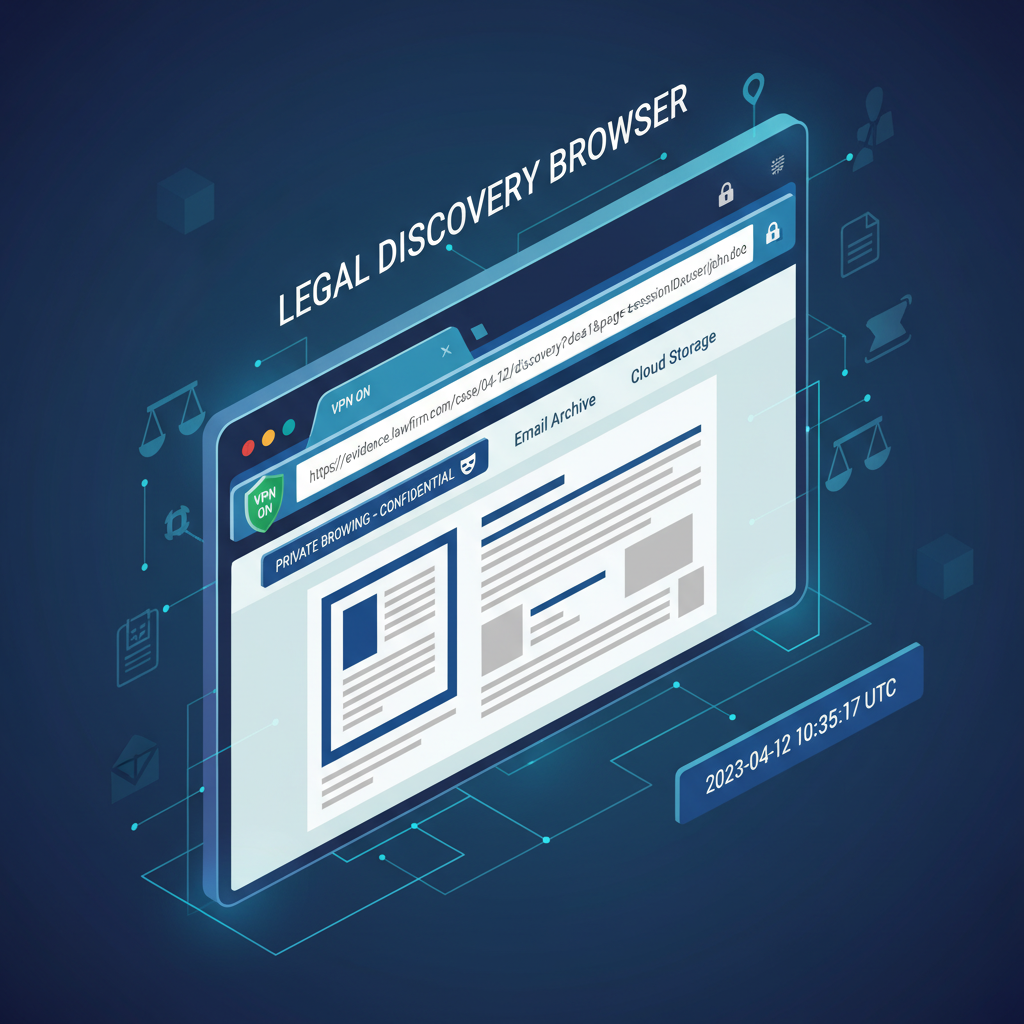
Standard screenshots are rarely sufficient for UDRP panels, as respondents often claim the evidence was doctored or produced in an atypical environment. Admissibility is supported by technical transparency, ensuring that the captured image reflects exactly what a potential customer sees when encountering an infringing domain. This level of detail is an important component of identifying bad faith registration through automated revenue streams.
- Geographic Verification: Use a VPN to access the domain from the brand’s primary market and the registrant’s location.
- Incognito Mode: Clear all cookies and cache to ensure that retargeted ads from your own browsing history do not appear on the page.
- Full URL Visibility: Ensure the address bar includes all tracking parameters and subdirectories generated by the parking service.
- Browser Headers and User-Agent: Record the browser type and version to prove the content was not served only to a specific bot scraper.
- OS-Level Time and Date Stamps: The system clock must be visible in the full-screen capture to verify when the monetization occurred.
A nuance often overlooked is the “local” ad variation. Parking providers use geo-targeting to maximize revenue, meaning a registrant in one country might see generic links, while a user in the trademark’s home jurisdiction sees direct links to competitors. Documenting these variations is essential for demonstrating commercial intent tailored to harm the brand owner. Beyond the visual capture, the specific links generated by these automated systems require a deeper semantic analysis.
Analyzing Link Relevancy and Keywords
Once the technical metadata is secured through the screenshot protocol, the focus shifts to the substance of the hosted content. The specific keywords and advertising links displayed on a landing page serve as primary indicators for domain-based revenue streams and, more importantly, the respondent’s intent to target a specific brand. WIPO panels frequently look beyond the mere existence of ads, analyzing whether the link categories are conceptually related to the complainant’s trademark. For instance, if a domain incorporating a fashion brand’s name displays links for “luxury handbags” or “designer shoes,” the commercial motivation becomes indisputable.
The strongest indication of bad faith is the presence of links leading directly to the trademark owner’s competitors. While squatters often claim ads are automatically generated by the registrar, the conceptual relevance of these links demonstrates that the domain’s value is derived entirely from the brand’s reputation.
Documenting these link blocks helps in establishing how to prove bad faith in a UDRP case because it creates a direct link between the trademark’s goodwill and the squatter’s profit. When the landing page utilizes high-value industry keywords, it shows that the domain was not chosen randomly but for its ability to siphon traffic from the legitimate brand owner. This documentation is vital when collecting evidence for a cybersquatting claim in scenarios where no active website exists, yet the intent to monetize remains clear through parked advertisements.
Understanding these content-driven signals naturally leads to an investigation into the platforms that enable such systematic monetization.
Parking Providers and Revenue Streams
This section examines the commercial entities facilitating monetization schemes. We will explore the technical architectures of major parking providers and address the common legal defense that registrars, rather than owners, control these advertisements.
Inside Major Parking Service Architectures
Platforms such as Sedo, Bodis, and GoDaddy CashParking operate monetization ecosystems where registrants share revenue with providers through automated ad delivery. These architectures rely on DNS redirection to populate domains with pay-per-click (PPC) ads. Legally, pointing nameservers to these services is viewed by panels as an active step toward commercial exploitation.
| Architecture Type | Mechanism | Bad Faith Implications |
|---|---|---|
| Standard PPC Page | Displays sponsored links based on the domain’s keywords. | Directly targets the brand’s goodwill for click-through revenue. |
| Zero-Click Redirect | Instantly forwards visitors to an affiliate or competitor site. | Aggressive diversion; effectively hijacks the consumer’s search journey. |
| Ad-Injection Wrappers | Uses frames or scripts to overlay ads on top of unrelated content. | Demonstrates an intent to profit from high-traffic keywords. |
A common mistake in domain name disputes is the respondent’s attempt to claim “automated innocence.” Respondents often argue they did not manually choose the ads; however, by entering a Terms of Service (ToS) agreement with a parking provider, the owner explicitly authorizes the commercial use of the traffic. For instance, documenting a transition from a “Coming Soon” page to a monetization server often serves as the “smoking gun” evidence of intent to profit from trademark confusion.
Forensic Evidence Checklist for Parking Revenue
- HTTP Header Analysis: Identify server response codes (e.g., 301/302 redirects) that point to known parking infrastructure (e.g., parkingcrew.net).
- Account ID Extraction: Locate publisher or affiliate IDs in the HTML source code to link multiple infringing domains to the same registrant.
- Keyword Relevance: Record if the automated links specifically reference the complainant’s industry or trademarks.
- Redirect Trace: Use tools like cURL or Wget to capture the full redirect path of Zero-Click architectures.
Identifying these redirects is critical as they represent a direct form of commercial diversion. Because these systems are dynamic, panels require high-quality forensic captures to confirm that the monetization was active at the time of the dispute. This systematic delegation of content often negates any defense based on “passive holding” or lack of direct involvement.
Note: This information is for educational purposes. Outcomes in UDRP or URS proceedings depend on specific evidence of bad faith and the discretion of the presiding panel.
Related topic reference: Proof of passive holding bad faith udrp strategies.
Expert Warning: The Default Defense
Expert Insight: Anton Polikarpov — The “registrar-default” defense fails to account for the registrant’s role as the ultimate architect of the domain’s technical stack. In forensic analysis, the choice to permit automated monetization is viewed as an affirmative act of commercial exploitation. Claiming ignorance of specific ad-feeds is irrelevant; as the publisher of record, the registrant bears full accountability for the content and the resulting revenue streams identified through digital archaeology.
Anton Polikarpov’s Insight: Registrant responsibility is absolute. Panels consistently rule that a domain owner is legally accountable for any content appearing on their site, including automated ads. By pointing Name Servers to a monetization service, the registrant makes a conscious choice to facilitate profit. The ‘automated’ nature of the ads is viewed as a technical detail, not a legal defense.
To dismantle this defense, your documentation of income from parked domains should be paired with the provider’s Terms of Service. Most platforms explicitly state that the registrant retains control over keyword triggers or, at the very least, receives a share of the resulting profits. Demonstrating this financial link proves that the registrant is a willing participant in the commercial cycle, effectively neutralizing the claim of passive ignorance. This shift from technical observation to legal culpability is what transforms raw data into a compelling case for bad faith.
The next logical step involves organizing these findings into a narrative that demonstrates clear trademark damage during the filing process.
Strategic Evidence Synthesis for Filing

Turning raw tracking data into a successful UDRP complaint requires framing revenue evidence as a deliberate exploitation of trademark goodwill. According to the WIPO Arbitration and Mediation Center standards, the presence of pay-per-click (PPC) links targeting a complainant’s specific industry is sufficient to establish bad faith, even if the ads are dynamically generated by a third party. Legal strategy must emphasize that the registrant’s choice of a parking provider—and the subsequent profit-sharing agreement—represents an active commercial pursuit rather than passive, accidental holding.
To build a cohesive narrative, practitioners should link specific ad categories to the likelihood of consumer confusion. For instance, in a dispute involving a fintech brand, evidence that a parked domain displayed links for “secure banking” or “loan applications” directly proves the respondent’s intent to profit from the complainant’s reputation. When preparing for Domain Name Disputes, counsel should present high-resolution screenshots alongside the parking provider’s Terms of Service to confirm that the registrant is contractually entitled to a share of the generated revenue. This synthesis bridges the gap between automated content feeds and intentional commercial gain, satisfying the burden of proof for bad faith under the UDRP policy.
Connecting the Revenue to Confusion
When synthesizing evidence for a legal filing, the primary objective is to demonstrate that domain-based advertising returns are a direct metric of brand erosion. In the context of Domain Name Disputes, commercial gain serves as a primary indicator of bad faith registration and use under the UDRP (specifically paragraph 4(b)(iv)). By mapping industry-specific ad categories to the complainant’s trademark, panels can conclude that the resulting consumer confusion is both intentional and monetized.
Quantifying Confusion: Hypothetical Traffic Diversion Impact
The following scenario illustrates how a typo-squatted domain or a parked page disrupts the user journey, diverting high-intent traffic away from the legitimate brand owner:
| Performance Metric | Official Brand Site | Parked Squatter Domain |
|---|---|---|
| Navigation Intent | Direct Brand Search | Typographical Error / Misdirection |
| Average Click-Through Rate (PPC) | N/A (Organic Content) | 18% – 25% (Aggressive Ad Feeds) |
| Consumer Experience | Product Fulfillment | Initial Interest Confusion |
This diversion creates measurable economic harm, even if the absolute revenue generated by the respondent is modest. According to the WIPO Overview 3.0, the mere intent to attract users for commercial gain by creating a likelihood of confusion is sufficient for a finding of bad faith. When a visitor lands on a parked page featuring links to direct competitors, the trademark’s distinctiveness is diluted, and the user’s navigation path is hijacked for the benefit of third-party advertisers.
To conclude the evidence synthesis, the focus shifts to procedural verification. Formatting the forensic findings to meet specific evidentiary standards allows legal counsel to present a clear link between the registrant’s infrastructure choices and the resulting brand damage from diverted traffic.
Final Preparation Checklist for Counsel
Once the link between revenue and consumer confusion is established, the focus shifts to the technical assembly of the filing. A comprehensive evidentiary package helps the panel see the monetization not as an accident of the registrar, but as a deliberate choice by the registrant. To prove bad faith in a UDRP case, counsel should supplement surface-level observations with a verifiable audit trail that connects the domain’s traffic to the respondent’s financial interest.
Preparing the final submission requires a rigorous verification of all digital assets. Without specific technical metadata, a respondent can easily claim that the screenshots are unrepresentative or that the ads were generated without their knowledge. The following data points are essential for a robust filing:
- Archival Whois Records: These documents must confirm that the respondent was the record holder at the exact time the monetization was most aggressive.
- High-Resolution Screenshot Logs: Images must include full browser windows with visible date-stamps, time-stamps, and the underlying Pay-Per-Click (PPC) link destinations.
- Network Traffic Headers: Capturing the ad-server headers provides forensic proof of which parking network was serving the content, neutralizing the “passive registrar” defense.
- Historic DNS Logs: Documentation of the transition from a legitimate name server to a known monetization server (like Sedo or ParkingCrew) demonstrates the intent to pivot toward commercial exploitation.
By consolidating Whois records, screenshot logs, tool reports, and parking provider IDs into a coherent narrative, counsel can effectively demonstrate bad-faith intent from the moment of registration. This meticulous approach to gathering proof of intent for domain disputes transforms raw data into a compelling legal argument, ensuring that revenue evidence becomes an irrefutable pillar of the complaint. To successfully secure your brand’s digital perimeter, partner with Claimon for expert support during the final filing process.
For help with this task, use the Domain Name Disputes service.
Securing Your Brand Through Data
Securing a favorable UDRP decision requires more than just claiming infringement; it demands a robust assembly of evidence of domain parking revenue that explicitly links the respondent’s profit to consumer confusion. While automated pay-per-click links provide the digital trail, a professional legal strategy ensures these technical findings translate into a definitive finding of bad faith. Reviewing specific UDRP bad faith registration examples offers deeper insight into successful recovery patterns and the rigorous documentation required. Contact Claimon to transform these forensic insights into the successful transfer and technical implementation of your digital assets.
Frequently Asked Questions
Can a trademark owner claim the actual parking revenue as damages in a UDRP proceeding?
No, the UDRP (Uniform Domain-Name Dispute-Resolution Policy) is an administrative process designed specifically to address the registration and use of domain names in bad faith. The only remedies available under this policy are the transfer of the domain name to the complainant or the cancellation of the domain. If a brand owner seeks to recover monetary damages or the profits earned by the cybersquatter through parking revenue, they must file a lawsuit in a court of competent jurisdiction, such as under the Anticybersquatting Consumer Protection Act (ACPA) in the United States.
Does removing the parking ads after receiving a cease-and-desist letter clear the registrant of bad faith?
Generally, no. UDRP panels focus on whether the domain was registered and is being used in bad faith. If historical evidence proves the domain was monetized using the complainant’s trademark, simply taking the ads down (often called “redemptive action”) does not typically erase the prior bad faith use. In fact, many panels view the sudden removal of ads after a legal threat as an admission that the monetization was improper. This is why capturing forensic evidence of the parking pages before contacting the registrant is a critical tactical step.
How do “Publisher IDs” help in proving a pattern of bad faith conduct?
When investigating parking revenue, specialists often look at the underlying source code for unique identifiers, such as Google AdSense IDs or Parking Provider Affiliate IDs. If an investigator finds the same ID across multiple domains that infringe on various trademarks, it proves a “pattern of conduct.” Under UDRP Paragraph 4(b)(ii), establishing that a respondent engages in a pattern of preventing trademark owners from reflecting their marks in domain names is a standalone ground for proving bad faith, making the case for transfer much stronger.
Are “zero-click” redirects treated differently than standard PPC parking pages?
Yes, from a strategic perspective. While standard Pay-Per-Click (PPC) pages show a list of links, “zero-click” or “top-level” redirects automatically send the visitor to another website, such as a competitor’s store or a promotional offer. UDRP panels often view these redirects as more egregious evidence of bad faith because the registrant is actively diverting traffic without any user interaction. This automated redirection leaves little room for the “registrar-default” defense, as it clearly demonstrates a commercial intent to intercept the complainant’s customers.
What happens if the parking ads are only visible to users in certain geographic regions?
Modern parking services often use geo-targeting to display different ads based on the visitor’s IP address. For example, a domain might show benign content to a visitor in Europe but show infringing, brand-specific ads to a visitor in the United States where the trademark is most active. To counter this, a thorough investigation must involve using a VPN or localized proxies to capture how the domain appears in different markets. Evidence showing that the registrant is specifically targeting the trademark owner’s primary customer base is highly persuasive to a panel.
Is “passive holding” still considered bad faith if there is no parking revenue being generated?
It can be. Under the landmark Telstra decision (WIPO Case No. D2000-0003), panels established that “passive holding” (keeping a domain at a blank page or “under construction” status) can still constitute bad faith. Factors that support this include:
- The trademark being highly well-known or famous.
- The registrant providing false contact information in Whois records.
- The lack of any plausible legitimate use for the domain.
While tracking revenue is the “smoking gun,” the absence of revenue does not automatically protect a cybersquatter if the registration itself was clearly aimed at the brand owner.