Capturing the smoking gun: Extortion emails

When a squatter demands an inflated price for your brand’s digital identity, aggressive messages transform from threats into primary evidence of bad faith registration. Collecting proof of intent for domain disputes allows you to leverage bad faith evidence in negotiations under UDRP Policy paragraph 4(b)(i) effectively, preparing the ground for the preservation of digital evidence for UDRP.
Preservation of digital evidence for UDRP
When documenting extortionate demands, seasoned UDRP panelists often view isolated screenshots with skepticism because they lack the technical provenance required to prove authenticity. To withstand scrutiny under evidentiary standards recognized by the WIPO Arbitration and Mediation Center, digital evidence should ideally include full SMTP headers. These headers provide a digital audit trail, capturing the sender’s IP address, the Message-ID, and the “Received” timestamps that trace the communication’s journey across mail servers.
Preserving the message in its original .eml or .msg format is the most reliable method to maintain this metadata, as it prevents the respondent from claiming the evidence was manipulated or fabricated. Beyond the body of the email, capturing the hidden routing information helps establish a clear link between the squatter and the bad faith attempt to sell the domain. For brand owners facing sophisticated cybersquatters, a professional evidence audit for Domain Name Disputes can help ensure that all gathered communications meet the rigorous criteria required to prove bad faith registration and use.
Step-by-step email preservation checklist
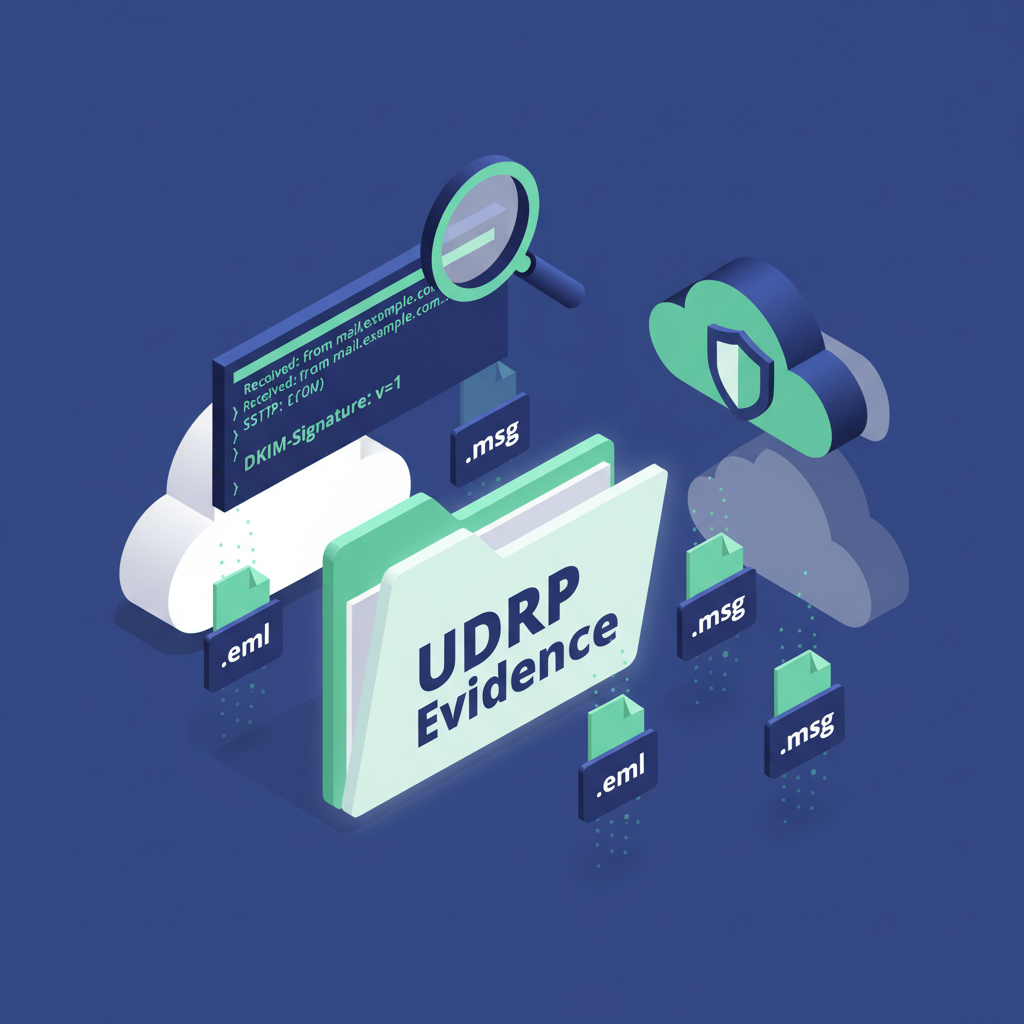
To ensure evidence admissibility in UDRP cases, preserve emails in native .eml or .msg formats to retain verifiable SMTP headers.
- Open the original extortion email in your mail client.
- Select “Save As” or “Export” to download the message as a .eml or .msg file.
- Verify that the saved file includes the hidden routing information (SMTP headers).
- Upload the native files to a secure cloud storage service for backup.
- Capture high-resolution screenshots of the email as a visual supplement.
- Organize all files in a folder labeled with the relevant domain name and date.
- Export native files: Save every message as a .eml or .msg file rather than a screenshot to maintain metadata integrity.
- Capture SMTP headers: Open the email “internet headers” or “original source” to document the IP address and server path of the sender.
- Preserve the landing page: Use tools that capture the live state of the domain, especially if it redirects to a “For Sale” page or mentions your brand.
- Log brokerage interactions: If the squatter uses a middleman, you must strictly document brokerage offers and any platform-specific chat logs.
- Record timestamps: Ensure all evidence is dated to prove that the offer to sell exceeded out-of-pocket registration costs.
- Audit for continuity: Verify that the chain of emails is complete, as missing replies can be exploited by the respondent to claim a “legitimate negotiation.”
- Export the email in .eml or .msg format to preserve all underlying technical metadata and prevent the registrant from reframing the dispute.
- Save the full internet headers to capture the routing history and sender’s IP address required for legal identification.
- Take high-resolution screenshots of the entire communication, ensuring that timestamps and sender details are clearly visible.
- Store all documented evidence in a secure cloud backup to maintain a tamper-proof record and prevent accidental data loss.
- Maintain a chronological interaction log to document the frequency and nature of the registrant’s demands over time.
- Verify that all captured technical data satisfies WIPO Overview 3.0 standards for proving bad-faith registration and intent.
Related topic reference: Udrp evidence of respondent bad faith in negotiations.
Identifying extortion vs. legitimate negotiations
Building on the distinction between bad faith and neutral communication, we define extortion in a legal context. This overview previews the nuances of distinguishing predatory demands from legitimate fair market valuations.
Extortion signs vs. Fair market valuation
Distinguishing between a professional asset transfer and a bad faith demand requires analyzing the underlying intent behind the communication. To avoid the “Do Not Reply Trap”—the risk that tactical silence will prevent you from documenting evidence of bad faith—recipients should categorize the communication using a neutral inquiry. Legitimate domain investors typically focus on the inherent value of a generic keyword or the traffic it generates, whereas extortionists leverage “nuisance value”—the cost of the disruption or legal fees you would face if you do not pay. According to the WIPO Overview 3.0, the mere act of offering a domain for sale is not inherently evidence of bad faith, but the context changes when the respondent specifically targets a trademark owner to extract a profit far exceeding out-of-pocket registration costs.
| Comparison Factor | Professional Brokerage (Fair Market) | Squatter Tactics (Extortion Signs) |
|---|---|---|
| Value Proposition | Based on generic keyword demand or traffic data. | Based on “nuisance value” (avoiding legal fees). |
| Language and Tone | Neutral, professional, and market-focused. | Aggressive, high-pressure, and threatening. |
| Targeting Logic | Offers the domain to a broad market of users. | Specifically targets brand owners to extract profit. |
| Negotiation Style | Standard business appraisal and counter-offers. | Arbitrary deadlines and “last chance” ultimatums. |
| Negotiation Marker | Professional Market Valuation | Bad Faith Pressure Tactics |
|---|---|---|
| Targeting Logic | The domain is marketed for its generic, descriptive, or phonetic appeal to any buyer. | Communications reference your specific trademark, recent product launch, or industry presence. |
| Tone and Timing | Formal, business-like dialogue that respects standard commercial review cycles. | Aggressive deadlines (e.g., “final offer expires in 12 hours”) or threats to sell to a competitor. |
| Pricing Justification | Based on historical data for similar keywords, TLD scarcity, and CPC metrics. | Arbitrary demands or “bidding wars” that only materialize once the brand owner expresses interest. |
Documenting these differences is essential for establishing a case under Paragraph 4(b)(i) of the UDRP Policy. If the respondent’s messages indicate they registered the domain primarily to sell it to the trademark holder for gain, this qualifies as evidence of bad faith. When managing Domain Name Disputes, capturing the initial reach-out is critical, as squatters often sanitize their language once they realize they are being scrutinized by legal counsel. Even if the demand is presented as a “voluntary offer,” any mention of your brand’s value or the potential harm of someone else owning the domain serves as a marker for panels to identify abusive registration.
Strategic response: The ‘Do Not Reply’ trap
After identifying predatory behavior, managing the interaction is crucial to avoid reverse domain name hijacking claims. We explore establishing a strategic communication flow to safely bait a squatter into an actionable demand.
Communication flow for evidence gathering
Proving bad faith requires more than showing an expensive offer; it requires a narrative of solicitation. A structured 4-week preparation timeline ensures that evidence meets the criteria defined in the WIPO Overview 3.0, demonstrating that the respondent’s primary intent was to profit from the trademark owner’s rights. This process starts with Week 1 (initial receipt and preservation of forensic email headers), proceeds to Week 2 (controlled engagement to elicit a commercial offer) and Week 3 (a cooling-off period followed by a formal cease-and-desist), and concludes in Week 4 with the final evidence compilation and filing of the UDRP complaint.
During Week 2, the “Neutral Inquiry” serves as the primary tactic to avoid the trap of silence. Instead of asserting trademark rights immediately—which often leads the squatter to enable privacy shields or scrub the site—ask for their “expectations regarding the transfer.” In one typical case, a respondent who initially claimed the domain was for a personal project immediately shifted to a $25,000 “consulting fee” once they realized a brand owner was the interested party. This sudden pivot is essential for successfully navigating Domain Name Disputes, as it directly supports a finding of bad faith under UDRP Paragraph 4(b)(i).
Checklist for Week 3 Monitoring:
- Has the respondent updated the MX records to simulate active use?
- Did a “For Sale” lander appear immediately after your first email?
- Has the respondent reduced the price in an unsolicited follow-up? (Evidence of pressure tactics).
Disclaimer: This content is informational and does not constitute legal advice. Domain dispute outcomes depend on the specific evidence of respondent behavior and trademark strength.
Presenting email evidence to the panel
This phase transforms gathered correspondence into a structured legal narrative. We examine how to organize these records to highlight bad faith and leverage tactical responses as definitive proof for the panel.
The power of the ‘Make an Offer’ trap

Panels frequently distinguish between a registrant simply holding a domain and one actively leveraging it for an unjustified payout. A common hurdle when proving a domain was bought in bad faith is the “defensive silence” tactic, where a squatter remains vague about their price to avoid the “intent to sell” trigger defined in UDRP Paragraph 4(b)(i). The ‘Make an Offer’ trap effectively shifts the burden, prompting the respondent to name a figure that exceeds any reasonable out-of-pocket registration costs.
Evidence Transformation: The Price Pivot Strategy
To illustrate how strategic documentation changes the legal landscape, consider this progression handled during professional Domain Name Disputes resolution:
- Initial Evidence (Before): A registrant sends an unsolicited email stating they are “considering offers” for a domain matching our client’s brand. On its own, this rarely meets the threshold for bad faith under the WIPO Jurisprudential Overview.
- Strategic Action (Eliciting Evidence): To avoid the trap of silence and document bad faith, we advised the client to respond with a neutral inquiry: “We are reviewing our digital assets. Do you have a specific expectation for this domain?”
- Resulting Evidence (After): The respondent replied with a demand for $25,000, explicitly referencing the client’s recent expansion. This transformed a vague interaction into definitive proof of bad faith registration and use.
Documenting these specific responses allows a legal team to frame the dispute around the respondent’s own words. When a squatter benchmarks their price against a company’s valuation rather than the domain’s generic utility, they provide the definitive evidence of bad faith required by UDRP panels. This methodical approach ensures that profit motive is recorded in a manner that satisfies the high evidentiary standards of ICANN-accredited providers.
Disclaimer: This content is provided for informational purposes only and does not constitute legal advice. Domain dispute outcomes depend on the specific facts of the case, respondent behavior, and current panel practices.
Related topic reference: How to document domain name brokerage offers.
Beyond emails: Corroborating the bad faith
While written records provide a foundation, winning a case requires looking past the inbox to external digital footprints. We examine how WHOIS history and technical shifts corroborate intent in my upcoming “Smoking Gun” theory.
Anton Polikarpov’s ‘Smoking Gun’ theory
In my experience, the “Smoking Gun” is rarely just the text of a demand; it is the precise synchronization between that communication and the respondent’s technical maneuvers. When a squatter initiates a “price pivot”—shifting from a neutral stance to an extortionate demand—they often simultaneously alter the domain’s public record to increase pressure. By mapping SMTP headers against historical registry updates, we can prove the domain was bought in bad faith through these documented patterns of predatory behavior.
The “Smoking Gun” is the timestamp correlation. If a respondent activates a privacy shield or updates their “for sale” lander within hours of receiving your inquiry, they are not a passive holder; they are an active, bad-faith negotiator whose actions confirm the extortionate intent of their correspondence.
Evidentiary Weight: Negotiation vs. Extortion
Categorize your evidence based on how panels weigh respondent behavior:
- Legitimate Negotiation: Direct responses to inquiries with valuations based on documented acquisition costs or industry-standard appraisals.
- Extortionate Conduct: Unsolicited offers with escalating price demands, threats of disparagement, or “exploding” deadlines designed to force a quick settlement.
Expert Insight: The Timing Factor
“The timing of an email is as critical as its content. Panels look for the ‘Smoking Gun’—a correlation between an outreach and a technical change. An extortionate demand that arrives the moment a domain’s DNS is updated to show competitor ads is rarely viewed as a coincidence by UDRP experts.” — Anton Polikarpov
To successfully gather proof of intent for domain disputes, you must cross-reference email delivery times with changes in DNS settings or WHOIS data. For example, if a respondent remains silent but the domain suddenly begins displaying PPC ads for your competitors immediately after your first contact, this “passive-aggressive” shift serves as non-verbal extortion. Documenting these coincidences allows panels to see the email not as an isolated incident, but as the verbal component of a broader cybersquatting scheme. This technical corroboration is often what bridges the gap when the respondent tries to claim their high price was merely a “fair market valuation” rather than a targeted demand.
This technical mapping provides the necessary weight to tilt the panel’s perspective, effectively turning a simple negotiation into a documented asset for your claim.
For help with this task, use the Domain Name Disputes service.
Turning extortion into your strongest asset
Properly documenting domain squatter extortion emails transforms a defensive headache into a surgical strike against bad faith registration. By capturing technical headers and correlating outreach with DNS changes, you build an unassailable record under UDRP Paragraph 4(b)(i) that panelists cannot ignore. If you are preparing for a dispute, understanding the nuances of UDRP evidence of respondent bad faith in negotiations ensures your strategy is grounded in procedural reality. At ClaimOn.name, we help you master these technical details to secure your brand’s digital perimeter with professional precision.
Frequently Asked Questions
How should I handle evidence if the domain squatter uses an anonymous brokerage platform instead of direct email?
When a squatter uses a third-party marketplace like Sedo, Afternic, or Dan.com to mask their identity, the evidence gathering shifts from personal communication to platform-specific records. You should document the public listing price, the date the domain was listed, and any “Buy It Now” figures that clearly exceed the out-of-pocket costs of registration. Under WIPO jurisprudence, a high public asking price for a domain that targets a specific trademark is often considered a functional equivalent to a direct extortion email.
For complex cases involving anonymous sellers, engaging Domain Name Dispute specialists can help in identifying patterns of behavior across multiple platforms, which panels use to establish a pattern of conduct under UDRP Paragraph 4(b)(ii).
Does a “without prejudice” disclaimer in a squatter’s email prevent me from using it as evidence in a UDRP case?
In most instances, no. While “without prejudice” labels are significant in formal litigation to protect settlement negotiations, UDRP panels typically take a more pragmatic approach. Panels generally hold that they are not bound by national evidentiary rules regarding settlement privilege. If an email contains a clear demand for an exorbitant sum in exchange for a trademark-infringing domain, the panel will usually admit it as evidence of bad faith registration and use, regardless of any legal disclaimers the sender attached to the message.
Can I use screenshots of WhatsApp, LinkedIn, or other social media messages as evidence of extortion?
Yes, non-email communications are increasingly common in modern cybersquatting cases. To ensure these messages carry weight with the panel, you must provide more than just a cropped screenshot. You should document:
- The full profile of the sender to establish a link between the social media account and the domain registrant.
- Time-stamped logs of the conversation.
- Contextual proof that the conversation was initiated by the respondent or was a direct response to a neutral inquiry.
Because social media messages are easier to manipulate than SMTP-verified emails, panels may subject them to higher scrutiny, so maintaining a clean chain of custody for these digital records is vital.
What are the translation requirements if the extortion email is written in a foreign language?
According to UDRP Rule 11, the language of the administrative proceeding is typically the language of the Registration Agreement (the contract between the squatter and their registrar). If your evidence—such as an extortionate email or a domain parking page—is in a different language, you must provide a full translation into the language of the proceeding. While some panels accept informal translations for preliminary review, it is best practice to provide a certified translation to ensure the respondent cannot challenge the accuracy of the “smoking gun” evidence during the response phase.
What happens if the squatter lowers their price significantly after I file a UDRP complaint?
A sudden drop in price after a complaint is filed—often referred to as a “fire sale” attempt—is frequently viewed by panels as a confirmation of bad faith. This behavior suggests the respondent recognizes the weakness of their legal position and is attempting to salvage some profit before the domain is transferred by order of the panel. You should document these late-stage offers and submit them as supplemental filings (if permitted by the provider) to reinforce the argument that the respondent’s primary motive was always commercial gain at the expense of the trademark owner.
Can I still prove bad faith if the squatter never responds to my emails?
If a squatter remains silent, you may need to rely on the doctrine of “passive holding.” Established in the landmark Telstra case, this principle allows panels to find bad faith even without a direct extortion demand. To succeed, you must demonstrate that your trademark is well-known, that the respondent has provided no evidence of any actual or contemplated good faith use, and that there is no conceivable good faith use for the domain in the hands of the respondent. In these cases, the lack of a response to a professional inquiry can actually support the claim that the respondent has no legitimate interest in the name.