Identifying the Legal Requirements for a UDRP Complaint
Securing a domain requires meeting the strict three-prong test of Policy 4(a), where failing even one criterion leads to immediate dismissal of your case. This guide explores the essential legal requirements for a UDRP complaint to help you navigate complex evidentiary standards.
Validating Your Trademark Rights Standing
Establishing a solid legal foundation requires verifying your trademark rights before addressing the respondent’s conduct. We will examine the nuances between registered and common law protections and the geographical limits of your standing.
Registered Marks vs Common Law Rights
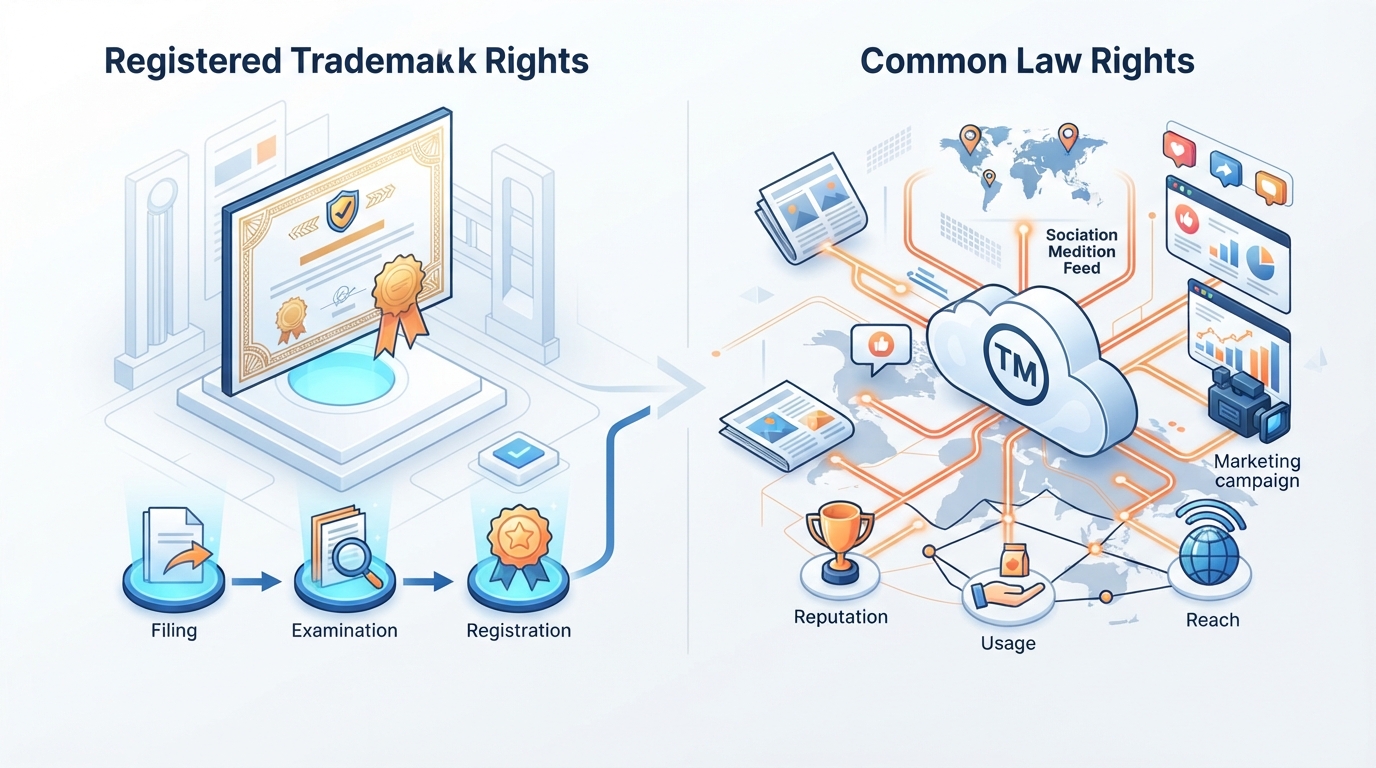
Within the framework of validating your standing, the policy does not strictly limit complainants to registered trademarks. However, the evidentiary burden shifts dramatically depending on the nature of your intellectual property. While a registration certificate from a national office creates a presumption of rights, establishing common law rights requires a deep dive into the WIPO Overview 3.0 standards to prove that the mark has acquired secondary meaning in the eyes of the consuming public.
For businesses operating without formal registrations, the panel expects extensive documentation to prove the brand functions as a source identifier. This requires demonstrating length and exclusivity of use, advertising expenditures, and media recognition to satisfy the heightened evidentiary burden compared to registered marks.
| Feature | Registered Trademark | Unregistered / Common Law |
|---|---|---|
| Presumption of Validity | Automatic upon providing certificate | None; must be proven from scratch |
| Evidence Required | Copy of registration (e.g., USPTO, EUIPO) | Sales data, ad spend, consumer surveys |
| Establishment Date | Filing or registration date | Date when secondary meaning was achieved |
| Difficulty Level | Low (administrative) | High (requires factual arguments) |
A common pitfall is assuming that a mere business name registration or social media handle constitutes a trademark; panels consistently reject these without proof of actual use in commerce as a distinctive identifier. Evidence of a long-standing digital presence and a loyal customer base serves as the bedrock for these claims.
Geographical Scope and Eligibility
A complainant’s standing to initiate a dispute relies on verifying their legal authority over the relevant trademark. Under WIPO Overview 3.0, panels require more than just a trademark registration certificate; they mandate proof that the specific entity filing the complaint holds the right to assert the mark. Common procedural failures arise when the complainant is an affiliate or subsidiary rather than the registered owner, or when the trademark has been subject to recent assignment without updated IP office records.
Geographical scope is less about physical borders and more about the relevance of the rights to the respondent’s activities. While a local registration is typically sufficient, the ICANN Uniform Domain Name Dispute Resolution Policy does not require the complainant and respondent to reside in the same jurisdiction. When asserting unregistered or common law rights, the evidentiary burden increases; complainants must demonstrate distinctiveness through factors like length of exclusive use, public recognition, and investment in advertising, as detailed in established panel practice.
| Evidence Type | Purpose |
|---|---|
| Certificate of Registration | Establishes formal ownership and current validity of the mark. |
| Assignment Documents | Verifies the chain of title if ownership was transferred. |
| Written Authorization | Confirms the right of a licensee or subsidiary to act for the mark owner. |
| Secondary Meaning Data | Proves distinctiveness for common law claims lacking registration. |
Ensuring documentation is properly verified is critical to avoiding procedural dismissals. Parties requiring assistance in assessing portfolio standing may consult professional legal services to navigate these jurisdictional and evidentiary complexities.
Disclaimer: This summary is for informational purposes. UDRP outcomes remain contingent on the specific facts of each case, the strength of the submitted evidence, and independent panel interpretation.
Related topic reference: Navigating the WIPO Overview 3.1 Evidence Requirements.
Proving Respondent Lacks Legitimate Interests
Proving that a respondent has no legitimate interest often involves pre-empting common defenses regarding fair use or non-commercial intent. We will analyze typical respondent justifications and the behavioral patterns that panels use to identify infringing activity.
Analyzing Common Respondent Defenses

Establishing a lack of legitimate interests often requires anticipating the respondent’s narrative before they even submit a response. While the complainant carries the initial burden, once a prima facie case is made, the respondent must provide evidence of their rights. Panels frequently see generic justifications that fail to meet the substantive threshold of Policy 4(c), making it essential to identify the evidentiary gap in these common claims.
Refuting the ‘Preparations to Use’ Defense
Respondent’s Claim: “I registered this domain because I was planning to launch a legitimate e-commerce business. I haven’t started yet, but I have a business plan and I am looking for suppliers.”
The Refutation: To successfully counter this, a complainant must highlight the lack of demonstrable preparations. Under WIPO standards, mere assertions are insufficient. We look for the absence of registered business entities, lack of trademark applications, or the failure to produce actual correspondence with third parties dated prior to the notice of the dispute. If the respondent has only a ‘coming soon’ page with pay-per-click links, the defense of legitimate business preparation typically collapses.
Respondents often attempt to claim they are “commonly known” by the domain name, even without a trademark. However, if the WHOIS data or corporate filings do not support this name prior to the dispute, the panel will likely dismiss the claim. Another frequent tactic involves claiming non-commercial fair use. This defense is undermined if the domain hosts advertising or redirects to a competitor, as such actions are inherently commercial and intended for profit. By focusing on these evidentiary inconsistencies, you can demonstrate that the respondent lacks rights or legitimate interests.
Uncovering these inconsistencies requires a deep dive into the digital footprint left by the registrant over time.
Assessing Patterns of Behavior
Systemic behavior provides the most compelling evidence of a respondent’s true intent, often revealing a commercial strategy that contradicts their claims of fair use. Identifying whether a registrant is a professional ‘domainer’ or a bad-faith actor involves analyzing their entire portfolio and historical activity to distinguish between legitimate investment and targeted exploitation.
- Analyze WHOIS History: Use historical WHOIS databases to check if the respondent has a history of losing similar cases. A pattern of registering domains that mirror famous trademarks is a strong indicator of bad faith.
- Review Archive Snapshots: Utilize tools like the Wayback Machine to see how the domain was used previously. If the site once hosted content related to your industry but now claims to be ‘parked,’ this demonstrates an awareness of your brand.
- Examine Reverse WHOIS Data: Identify other domains owned by the same entity. If they own dozens of domains matching protected brand names, it proves a pattern of conduct intended to prevent trademark holders from reflecting their marks in corresponding domains.
- Verify Commercial Activity: Look for evidence of ‘warehousing.’ If the domain is offered for sale at a price far exceeding out-of-pocket registration costs without any associated business, it suggests the primary motive was commercial gain at the expense of the brand owner.
Distinguishing between a legitimate non-commercial enthusiast and a professional cybersquatter requires looking at the technical setup of the domain. For instance, the presence of MX records (used for email) often indicates an intent to use the domain for phishing or impersonation, which serves as a critical factor in satisfying the legal requirements for UDRP complaints. When a respondent’s portfolio consists almost entirely of typosquatted variations of known brands, the argument for ‘non-commercial fair use’ becomes legally indefensible.
Documenting these behavioral patterns creates a foundation for the final and most critical stage of the process: proving the dual elements of bad faith.
Demonstrating Bad Faith Registration and Use
Establishing bad faith requires satisfying a dual standard where both the acquisition and the subsequent activity of the domain holder demonstrate an intent to exploit a protected mark. This section explores the conjunctive proof requirement and identifies specific indicators panels use to determine the registrant’s underlying motives.
The Conjunctive Proof Requirement

Establishing bad faith under the Uniform Domain-Name Dispute-Resolution Policy is a conjunctive requirement. Per Policy 4(a)(iii), a complainant must demonstrate that the domain was both registered and is being used in bad faith. This temporal link frequently causes complaints to fail when evidence covers current infringement but lacks a nexus to the moment of registration. According to the WIPO Overview 3.0, panels specifically evaluate the respondent’s intent at the exact point of acquisition.
Expert Call-out: The Temporal Trap
Panels strictly require that bad faith coincides with the domain’s acquisition. If a respondent legitimately registered a name before the complainant established trademark rights, the claim typically fails. However, the “registration” date can legally “reset” if a domain expires and is re-acquired by a squatter. Navigating these complexities is central to success, as it prevents respondents from relying on outdated registration timelines.
To satisfy the evidentiary burden, complainants should utilize the following indicators to demonstrate bad faith across the domain lifecycle:
| Indicator Type | Evidence Focus |
|---|---|
| Registration | WHOIS history showing acquisition after trademark emergence. |
| Use | Passive holding vs. active traffic diversion (PPC). |
| Pattern | Documented evidence of blocking or defensive registration tactics. |
Disclaimer: Outcomes are case-specific and depend on the unique evidence provided and current panel practice; this content is provided for informational purposes and does not constitute legal advice.
Types of Bad Faith Indicators
Once the conjunctive requirement of registration and use is established, the focus shifts to categorizing the respondent’s actions into recognized patterns of misconduct. Panels do not look at these actions in isolation; they evaluate the totality of the circumstances to determine if the primary purpose of the registration was to disrupt a competitor or profit from a brand’s goodwill. High-weight indicators of bad faith provide the objective proof needed to overcome a respondent’s claims of coincidence or fair use.
These indicators often reveal a systemic approach to cybersquatting rather than a one-time oversight. Panels typically prioritize the following types of evidence:
- Extortionate Sale Offers: Evidence that the respondent offered the domain for sale to the trademark owner (or a competitor) for an amount significantly exceeding out-of-pocket registration costs.
- Website Traffic Diversion: The use of the domain to intentionally attract internet users for commercial gain by creating a likelihood of confusion with the complainant’s mark, often seen in the form of Pay-Per-Click (PPC) landing pages.
- Pattern of Blocking: Proof that the respondent has registered the domain to prevent the trademark owner from reflecting the mark in a corresponding domain, provided there is a documented pattern of such conduct across multiple brands.
- Disruption of Competitors: Registering a domain primarily for the purpose of interfering with the business operations of a direct competitor, often by redirecting traffic to a rival service.
In many cases, the absence of an active website—known as “passive holding”—can still constitute bad faith if the complainant’s mark is famous and there is no conceivable good faith use for the domain. Our team specializes in mastering the UDRP burden of proof for complainants by unearthing these hidden behavioral markers that link a respondent’s portfolio to a clear intent to infringe. Successfully documenting these patterns is the final evidentiary step before moving toward a formal filing.
Gathering this evidence prepares the groundwork for the final phase of the process: translating these findings into a persuasive legal submission.
Related topic reference: Mastering the UDRP Burden of Proof for Complainants.
For help with this task, use the Domain Name Disputes service.
Taking Action on Your Manufacturer Filing
While the Policy 4(a) criteria provide a standardized framework, the success of your filing hinges on the precision with which you map your evidence to the specific legal requirements for a Brand complaint. A poorly constructed submission does more than just lose a domain; it creates a public record of a failed enforcement action that can embolden future cybersquatters and diminish the perceived strength of your trademark. To ensure your case survives panel scrutiny and achieves a transfer, you must rigorously master the evidentiary standards necessary to displace a bad-faith registrant. We recommend conducting a comprehensive case audit before submission to address potential gaps in your strategy and secure your digital brand identity.
Frequently Asked Questions
What happens if my UDRP complaint is denied?
If a UDRP panel denies your complaint, the domain name will remain with the current registrant. Unlike a court proceeding, a UDRP decision is not strictly res judicata, meaning that in very specific and rare circumstances involving new, compelling evidence that was not previously available, a complainant might theoretically attempt a re-filing; however, this is highly discouraged and rarely successful.
It is important to understand that a denial is often final regarding the administrative process. If you believe the panel reached an incorrect decision, your next step is typically to seek relief through a court of competent jurisdiction under the ICANN UDRP Rules, specifically Article 4(k). Engaging in expert assistance for domain name disputes before filing is the most effective way to avoid the costly and time-consuming pitfalls of a rejected complaint.
Can I file a UDRP complaint for a domain that contains my brand name but includes additional words?
Yes, you can file a complaint even if the domain is not an exact match for your trademark. The UDRP standard assesses whether the domain name is confusingly similar to a mark in which the complainant has rights. Panels frequently rule in favor of complainants in cases involving:
- Typosquatting: Subtle misspellings of your brand.
- Descriptive suffixes: Adding words like ‘support’, ‘help’, ‘login’, or ‘official’ to your trademark.
- Geographic indicators: Adding city or country names that imply an official affiliation.
The panel will evaluate the overall impression of the domain. If the added elements do not sufficiently distinguish the domain from your trademark, or if they actually heighten the risk of consumer confusion, you may still meet the standing requirement for the first prong of the UDRP test.
Is the WHOIS information always sufficient to identify the respondent?
Relying solely on WHOIS data is a common point of failure for complainants. Due to privacy services and proxy registrations, the individual or entity listed in the public WHOIS record is often a service provider rather than the actual beneficial owner of the domain.
To build a robust case, you must look beyond the initial WHOIS snapshot. This includes:
- Using historical WHOIS databases to see if the contact details were recently changed to obscure the true owner.
- Investigating the website content associated with the domain to find hidden contact forms or unique identifiers.
- Requesting the registrar to disclose the underlying registrant’s identity if you have a prima facie case of infringement.
Failing to identify the proper respondent can result in a procedural delay or a dismissal if the panel determines the wrong party was named.
How long does the average UDRP process take from filing to final decision?
The UDRP process is designed to be an expedited alternative to traditional litigation. Generally, the entire procedure from the filing of the complaint to the rendering of a decision takes approximately 60 to 90 days.
The timeline includes specific phases defined by the WIPO Supplemental Rules, including:
- The Registrar Verification period.
- The Notification of Complaint (allowing the respondent 20 days to file a Response).
- The Appointment of the Panel.
- The Decision rendered by the panel (usually within 14 days of their appointment).
Note that this timeline can be extended if parties request suspensions for settlement discussions or if the panel requests additional submissions to clarify complex factual issues.
Does owning a trademark in one country allow me to win a UDRP case against a global domain?
Yes, the UDRP does not have a formal ‘territoriality’ requirement in the same way traditional court litigation does. Because the UDRP is a global policy, a panel may find that you have standing based on a trademark registered in your home country, even if the respondent is located elsewhere.
However, you must still prove that the respondent is targeting your specific market or that your mark has achieved sufficient global recognition (secondary meaning) to support a finding of bad faith. If your trademark is exclusively local and the domain usage is clearly directed toward a non-conflicting market or niche, the panel may be less likely to find that the domain was registered in bad faith to target your specific rights.