Proving Bad Faith in UDRP: The Legal Strategy
Proving bad faith in UDRP proceedings remains the most significant hurdle for trademark owners seeking to recover their digital assets. We will examine how objective facts reveal a registrant’s intent and establish the legal threshold for success.
UDRP evidence of respondent bad faith analysis
Effectively demonstrating how to prove bad faith in a UDRP case requires a meticulous analysis of the evidence of respondent bad faith through a digital footprint audit and behavioral scrutiny. This begins with aggressive evidence collection and a deep dive into the registrant’s prior conduct.
Evidence collection for UDRP proceedings

Practitioners must first capture the domain’s digital footprint before the registrant can alter or delete evidence. Under the Uniform Domain-Name Dispute-Resolution Policy (UDRP) framework, panels rely heavily on time-stamped screenshots and historical records from platforms like Archive.org to establish a baseline of use. This data is critical for collecting evidence for a successful cybersquatting claim, as it preserves traces of pay-per-click (PPC) link directories or competitor advertisements that a respondent might later “scrub” from the site to simulate legitimate use.
Professional management of Domain Name Disputes prioritizes documenting direct registrant interactions. Capturing brokerage offers and settlement demands exceeding out-of-pocket costs is essential, as these constitute core evidence of bad faith under WIPO Overview 3.0. Expert analysis involves preserving email headers and time-stamped logs to ensure negotiations are admissible. Furthermore, tracking historical WHOIS data for the sudden adoption of privacy services following a brand’s inquiry is vital to expose registrant attempts to evade legal service or conceal patterns of abusive registration.
Related topic reference: Udrp evidence of respondent bad faith analysis.
Analyzing the respondent’s prior conduct
Building upon the systematic evidence collection for UDRP proceedings, the focus must shift from what the respondent is doing now to what they have done in the past. A registrant’s history often provides the most damning evidence of intent. While individual instances of domain registration might appear coincidental, panels frequently rely on Paragraph 4(b)(ii) of the Policy to identify a pattern of conduct that prevents a trademark owner from reflecting their mark in a corresponding domain. Uncovering the respondent’s prior involvement in similar disputes is a primary tactical objective, as a demonstrated pattern of conduct significantly lowers the burden of proof for the complainant.
A “pattern of conduct” does not require dozens of cases; even two or three prior losses against unrelated brand owners can suffice to lower the complainant’s evidentiary burden. Panels view recidivism as an indicator that the current registration was not an accidental overlap but a calculated attempt at cybersquatting. This behavioral scrutiny extends to several key factors:
- Previous UDRP decisions: Searchable databases reveal if the respondent has a history of losing domains to legitimate mark holders, which establishes a baseline of abusive behavior.
- Bulk registration activity: Identifying that the respondent holds a portfolio of “brand-adjacent” names suggests a business model built on IP infringement rather than legitimate domain investment.
- Timing of acquisition: Proof that a respondent registered the domain immediately after a trademark became public or a product was announced elsewhere.
Documenting these prior actions transforms a subjective claim of “malice” into an objective demonstration of professional cybersquatting. Unmasking a pattern of behavior effectively sets the stage for the next legal hurdle: determining whether the specific act of registration and the subsequent use of the domain both meet the high threshold for bad faith required by the Policy.
Related topic reference: Collecting evidence for cybersquatting claim success.
Distinguishing bad faith registration and use
Navigating the dual necessity of establishing both abusive registration and subsequent bad faith use is essential. We will examine how this conjunctive requirement functions in practice and explore the notable passive holding exception.
The conjunctive requirement in practice
Under the conjunctive requirement of Paragraph 4(a)(iii) of the Policy, a complainant must prove that the domain name was both registered and is being used in bad faith.
Under the UDRP’s conjunctive standard, a complainant must establish that the domain name was both registered and is being used in bad faith. This requirement is often decisive in cases where a respondent registers a descriptive or generic domain name before the complainant acquires trademark rights. In such scenarios, even if the subsequent use targets the brand, the complaint will generally fail because the initial registration was not in bad faith. This differs significantly from certain national jurisdictions where a “disjunctive” (either/or) standard applies, allowing for a finding of bad faith based on registration or usage intent independently.
| Framework | Legal Standard | Bad Faith Requirement |
|---|---|---|
| UDRP | Conjunctive | Bad faith registration and bad faith use |
| National Jurisdictions | Disjunctive | Bad faith registration or bad faith use |
| Jurisdiction / Policy | Bad Faith Nexus | Practical Impact for Brand Owners |
|---|---|---|
| ICANN UDRP (gTLDs) | Conjunctive (“And”) | Requires proof that the respondent had the trademark in mind at the moment of purchase. |
| Nominet (.uk) | Abusive Registration | Focuses on whether the registration or use takes unfair advantage of the rights holder. |
| Spanish (.es) / Italian (.it) | Disjunctive (“Or”) | Easier to prevail if bad faith usage starts long after a legitimate registration. |
As noted in the WIPO Overview 3.0, panels rarely acknowledge “retroactive bad faith.” For instance, if a registrant acquired “cloud-storage.com” in 2010 and a company named Telstra Corporation Limited formed in 2022, the later use of the domain to redirect to a competitor might be abusive, but the 2010 registration itself remains “clean” under the conjunctive rule. Understanding these jurisdictional nuances is vital when deciding whether to file a UDRP complaint or pursue local litigation.
Note: This information is for educational purposes and does not constitute legal advice. Outcomes in domain arbitration depend on the specific evidence of intent and the consensus view of the presiding panel.
Exception: The passive holding doctrine

While the conjunctive requirement in practice generally necessitates evidence of both registration and active use, panels have long recognized that a cybersquatter cannot escape liability simply by leaving a domain empty. The passive holding doctrine, established in the landmark case Telstra Corporation Limited v. Nuclear Marshmallows (WIPO Case No. D2000-0003), provides a framework for transfer orders even when the respondent has not yet developed a website or is merely displaying a generic registrar parking page.
Under this doctrine, bad faith is inferred from the totality of circumstances. A complainant can effectively demonstrate proof of passive holding bad faith udrp by highlighting factors such as the high reputation of their trademark, the respondent’s failure to provide a credible explanation for the registration, and the lack of any conceivable good faith use for the domain. In such scenarios, the very act of withholding the name from the rightful owner is viewed as a form of use intended to block the brand’s digital expansion.
A ‘parked’ page is often more damaging than an active, infringing one. In my practice, I have seen how a dormant domain creates a digital vacuum, preventing the trademark owner from establishing a secure communication channel with customers while the squatter waits for the brand’s value to peak before initiating a sale.
When assessing bad faith in cases involving non-use, the focus is on the respondent’s inability to provide evidence of any preparation to use the domain for a legitimate purpose. If the domain consists of a well-known brand name and is held by an individual with no rights to it, the panel will typically find that the domain was both registered and used in bad faith. This strategic shift from active infringement to passive obstruction is a common tactic that leads directly into cases involving disruptive intent in domain disputes.
Proving disruptive intent in domain disputes
This section examines how to demonstrate that a domain was acquired to hinder a competitor’s market position, specifically focusing on identifying competitive relationships and documenting evidence of intentional business interference.
Identifying the competitive relationship
In the context of proving disruptive intent in domain disputes, the first hurdle is establishing that a competitive relationship actually exists. Paragraph 4(b)(iii) of the Policy does not require the parties to be direct rivals in the same narrow industry; rather, it looks at whether the respondent’s actions target the complainant’s market share or hinder their ability to reach their specific audience. If the parties operate in overlapping sectors or target the same demographic, the panel is more likely to find that the domain was registered primarily to disrupt the business of a competitor.
To establish this link, we analyze evidence of overlapping services and shared target audiences. In many udrp bad faith registration examples, the competitive relationship is proven by the respondent’s use of the domain to link to a rival’s website or by the registration of a name so similar to the complainant’s that it diverts organic search traffic. This diversion constitutes a tangible loss for the trademark owner, even if the respondent does not immediately profit from the redirected visitors.
Market Disruption Impact
Consider a hypothetical scenario where an established electronics retailer loses their intended ‘.com’ extension to a respondent who points the domain to a ‘coming soon’ page. Before the registration, the retailer’s brand queries led directly to their storefront. After the registration, search engine results are split, and consumer traffic to the retailer’s legitimate site drops by 15% as users are confused by the dormant placeholder. This drop in traffic, combined with the similarity of the domain, serves as powerful udrp evidence of respondent bad faith based on business disruption.
Proving this intent requires a deep dive into the respondent’s history and the timing of their registration relative to the complainant’s market entry. Once the competitive link is identified, the focus shifts to documenting specific instances of intentional business interference.
Evidence of intentional business interference
Once the competitive landscape is mapped, your strategy must pivot toward documenting the respondent’s overt actions. Proving bad faith in a UDRP proceeding under Paragraph 4(b)(iii) requires tangible evidence that the domain was registered primarily to disrupt your operations. This often manifests through the systematic siphoning of your digital audience. I recommend starting with a meticulous audit of all communication, such as emails or social media posts, to gather proof of intent to interfere with your business.
Documenting the “diversion” of customers to a competitor’s site is a technical process that requires more than just a single screenshot. To build a winning case, you should follow these specific evidentiary steps:
- Live Traffic Snapshots: Use high-resolution captures to show “sponsored listings” or “related links” on the respondent’s landing page that redirect users to your direct market rivals.
- Metadata Analysis: Examine the site’s source code for hidden meta-tags or keywords that specifically target your brand name to manipulate search engine rankings.
- Historical Context: Utilize digital archives to prove the respondent changed the site content immediately after your brand gained market traction, demonstrating a reactive, predatory intent.
It is a common misconception that the respondent must personally profit from this interference for a claim to succeed. In practice, establishing bad faith registration and use only requires showing that your business suffered a loss—such as a dip in organic search conversions—due to the respondent’s presence. By collecting evidence for cybersquatting claim success early, you prevent the registrant from scrubbing their digital footprint before the panel reviews the filing. This disruptive behavior serves as a bridge to more complex monetization schemes, where the registrant seeks commercial gain through calculated consumer confusion.
Related topic reference: Gathering proof of intent for domain disputes.
Establishing commercial gain through confusion
Beyond mere disruption, we must analyze how registrants profit from consumer error. This section examines the legal standards for likelihood of confusion and the various methods used to monetize deceptive domain traffic.
The likelihood of confusion standard
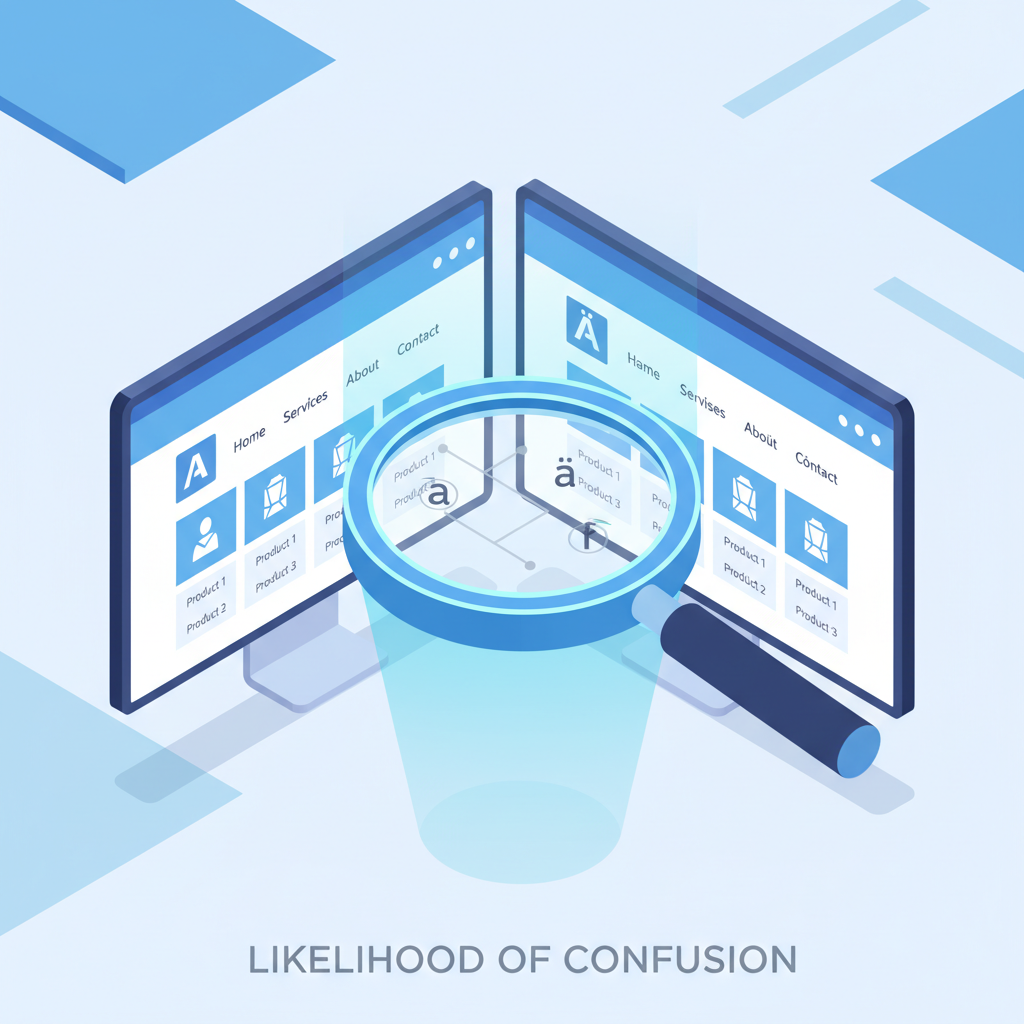
Under Paragraph 4(b)(iv) of the UDRP, the likelihood of confusion standard focuses on whether a “reasonably prudent internet user” would mistakenly believe the respondent’s website is authorized by the trademark owner. This assessment goes beyond a simple character-by-character comparison. As detailed in the WIPO Overview 3.0, panels apply a multi-sensory test to evaluate how a domain name functions as a deceptive bridge to the respondent’s content.
| Similarity Metric | Bad Faith Indicators |
|---|---|
| Visual Similarity | Use of “look-alike” characters (e.g., replacing ‘m’ with ‘rn’) or mirroring the complainant’s specific CSS/favicon to create a familiar “aura.” |
| Phonetic Similarity | Intentional targeting of “voice search” users or radio-advertised brands where the domain sounds identical to the mark despite different spelling. |
| Conceptual Equivalence | Registering the foreign language translation of a famous mark or using synonyms that evoke the same brand identity in the consumer’s mind. |
A common pitfall in these cases is the “Disclaimer Trap.” Respondents frequently argue that a footer stating “We are not affiliated with…” proves they are acting in good faith. However, UDRP panels generally apply the doctrine of initial interest confusion. This doctrine holds that the bad faith occurs the moment a user is lured to the site by a deceptive domain name. By the time the user reads a disclaimer, the respondent has already achieved their goal: capturing traffic, harvesting data, or generating ad-click revenue. Because a disclaimer cannot retroactively fix a deceptive registration, navigating these evidentiary nuances often requires professional assistance with Domain Name Disputes.
Practical Example: The Typosquatting Pivot
Consider a respondent who registers a variant of a financial institution’s domain, such as [Brand]Login-Secure.com. Even if the website features a disclaimer and distinct colors, the choice of the domain itself suggests an intent to capitalize on the trademark’s reputation for security. Panels often view the combination of a trademark with descriptive terms like “login” or “verify” as evidence that the confusion was engineered to facilitate commercial gain or data interception.
While UDRP outcomes depend on specific evidence and panel discretion, documenting the user journey—from the initial search to the landing page—is critical for proving that the confusion was intentional and not incidental.
Monetizing the confusion: Ad-sense and Phishing
While the likelihood of confusion standard identifies the mechanism of the infringement, the actual monetization of that confusion provides the definitive proof of commercial intent. In many instances, the respondent does not even need to sell a competing product; the mere act of attracting users to a parked page filled with Pay-Per-Click (PPC) links satisfies the requirement for bad faith under Paragraph 4(b)(iv). By leveraging your brand’s reputation to generate traffic for ad networks, the registrant is deriving direct financial benefit from the diversion of your potential customers.
Under the UDRP, automated ad-farms and domain parking services constitute intentional commercial gain even if the registrant did not manually select the links. Panels consistently rule that a domain owner is responsible for the content of their website. If the parking service generates revenue by displaying links related to the complainant’s industry or brand, it serves as objective evidence of bad faith registration and use, as the respondent is effectively siphoning the value of the trademark for profit.
Beyond passive ad revenue, phishing represents a more aggressive and damaging form of monetization. Proving bad faith in UDRP cases involving phishing requires technical documentation of active mail exchange (MX) records or server logs that indicate the domain is being used to harvest credentials. Unlike standard cybersquatting, where the goal is often a high-value sale, phishing aims to extract value through identity theft or corporate espionage. Capturing screenshots of deceptive login portals or documenting fraudulent email headers is critical to showing that the domain was bought and used specifically to facilitate illicit commercial gain through deceptive practices.
These monetization tactics, ranging from subtle ad-sense links to overt fraudulent schemes, provide documented evidence of intentional commercial gain.
For help with this task, use the Domain Name Disputes service.
Mastering the Burden of Proof
Success in domain litigation is rarely about the facts alone, but rather the structured legal framework used to present them to the panel. By understanding exactly how to prove bad faith in a UDRP case—from analyzing passive holding scenarios to gathering proof of intent for domain disputes—you move beyond mere allegations to providing the concrete evidence required for a transfer order. If your intellectual property is being targeted by a squatter or diluted by unauthorized use, a rigorous and professional evidentiary strategy remains your most effective tool for reclaiming and protecting your digital assets.
Frequently Asked Questions
Can bad faith be established if the domain was registered before the complainant obtained their trademark?
The general rule under the UDRP is that bad faith registration cannot be found if the domain was registered before the complainant had trademark rights. However, there are two significant exceptions to this rule that practitioners must consider:
First, bad faith may be found if the domain was registered in anticipation of the complainant’s rights. This often occurs when a respondent learns of a forthcoming brand launch, a merger, or a trademark application and ‘front-runs’ the registration to extort the future owner. Second, if the complainant had significant unregistered (common law) rights at the time of the domain registration, the panel may find bad faith even if the formal registration came later.
Evidence such as prior business negotiations between the parties or the respondent’s knowledge of the complainant’s industry can be pivotal in these specific cases.
What is ‘Reverse Domain Name Hijacking’ and how does it impact a case?
Reverse Domain Name Hijacking (RDNH) is a finding by a UDRP panel that a complainant has attempted to use the policy in bad faith to deprive a registered domain name holder of a domain. This is essentially ‘bad faith’ on the part of the trademark owner. A panel may declare RDNH if the complainant knew they lacked trademark rights, or if they clearly filed the case despite knowing the respondent had a legitimate interest.
While an RDNH finding does not carry a financial penalty under the UDRP itself, it is a serious blow to a company’s reputation and is recorded in public WIPO or NAF databases. It can also be used as evidence in subsequent court proceedings under national laws like the Anticybersquatting Consumer Protection Act (ACPA) in the United States.
How does a domain renewal affect the requirement to prove ‘registration’ in bad faith?
One of the more nuanced areas of UDRP law is whether the renewal of a domain registration counts as a new ‘registration’ for the purpose of Paragraph 4(a)(iii). The consensus view among WIPO panels is that a standard renewal does not constitute a new registration. This means that if a domain was originally registered in good faith ten years ago, a simple renewal today—even if the owner is now aware of your trademark—usually does not satisfy the bad faith registration requirement.
However, a change in the beneficial ownership of the domain is treated as a new registration. If the domain was transferred from one entity to another, the date of that transfer is the new ‘registration’ date. Proving bad faith at the time of that specific transfer is sufficient to meet the UDRP criteria.
Is ‘willful blindness’ a valid argument for proving bad faith against domain investors?
Yes, the concept of willful blindness is frequently applied to professional domainers or bulk registrants. While an individual may claim they didn’t know a specific trademark existed, professional investors are expected to perform basic due diligence. If a respondent registers hundreds or thousands of domains and fails to use automated tools to screen for trademark conflicts, panels may find that they were willfully blind to the infringement.
Panels often argue that sophisticated registrants cannot ‘close their eyes’ to obvious trademark rights to maintain a defense of good faith. Evidence of a pattern of conduct, where the respondent has lost previous UDRP cases involving different trademarks, is the most common way to support a willful blindness argument.
Can a domain owner defend against bad faith by using a disclaimer on the website?
The use of a disclaimer—such as ‘This site is not affiliated with [Brand Name]’—is rarely a successful defense against a claim of bad faith. UDRP panels generally follow the Initial Interest Confusion doctrine. This doctrine suggests that the harm is done the moment the user is confused into clicking the link or typing the URL based on the trademark.
A disclaimer does not ‘cure’ bad faith because:
- The respondent has already successfully diverted traffic intended for the trademark owner.
- The domain itself remains confusingly similar, regardless of the content on the landing page.
- Disclaimers are often seen as an admission that the respondent knew of the trademark and is attempting to circumvent the policy.
How do UDRP panels view the use of privacy services in determining bad faith?
While using a privacy or proxy service is not inherently an act of bad faith, panels often view it as a contributing factor when combined with other suspicious behaviors. According to the WIPO Jurisprudential Overview 3.0, the use of such services to shield the respondent’s identity can support an inference of bad faith if the respondent fails to provide a credible explanation for the registration or if the service was used specifically to evade legal process.
Indicators that privacy services are being used in bad faith include:
- Switching to a privacy service immediately after receiving a cease-and-desist letter.
- Providing false or incomplete contact information to the privacy provider.
- A history of using privacy services to hide registrations that infringe on well-known trademarks.
In many domain name disputes, the panel will look at the ‘totality of circumstances’ to decide if the privacy shield was used for legitimate security reasons or to facilitate cybersquatting.